Earthquake-Resistant Building Models
Design multi-story building prototypes that absorb the destructive effects of seismic waves, maintain structural integrity and safely preserve the payload inside.
When the ground moves, will your design stand?
Your team designs a miniature building that can withstand a simulated earthquake. You investigate how its shape, joints and bracing affect movement, then test ideas and refine a design that balances strength, flexibility and careful use of materials.
Students build the official structure at the event and explain the choices behind it. The building is then tested on a shake table with a load placed on its roof. Each successful stage leads to a more demanding test, showing how the design behaves as the shaking increases.
The competition recognises the engineering journey as well as the test result, through independent awards. Record what you tried, what failed and what you improved. The technical sections and official rulebook explain construction limits, roof-load requirements, test conditions and award criteria.

Building Model Specifications & Limits
Allowed Materials
Balsa wood or basswood sticks for the main frame; thin MDF or plexiglass (max. 3 mm thickness) for floor surfaces.
Innovation Freedom
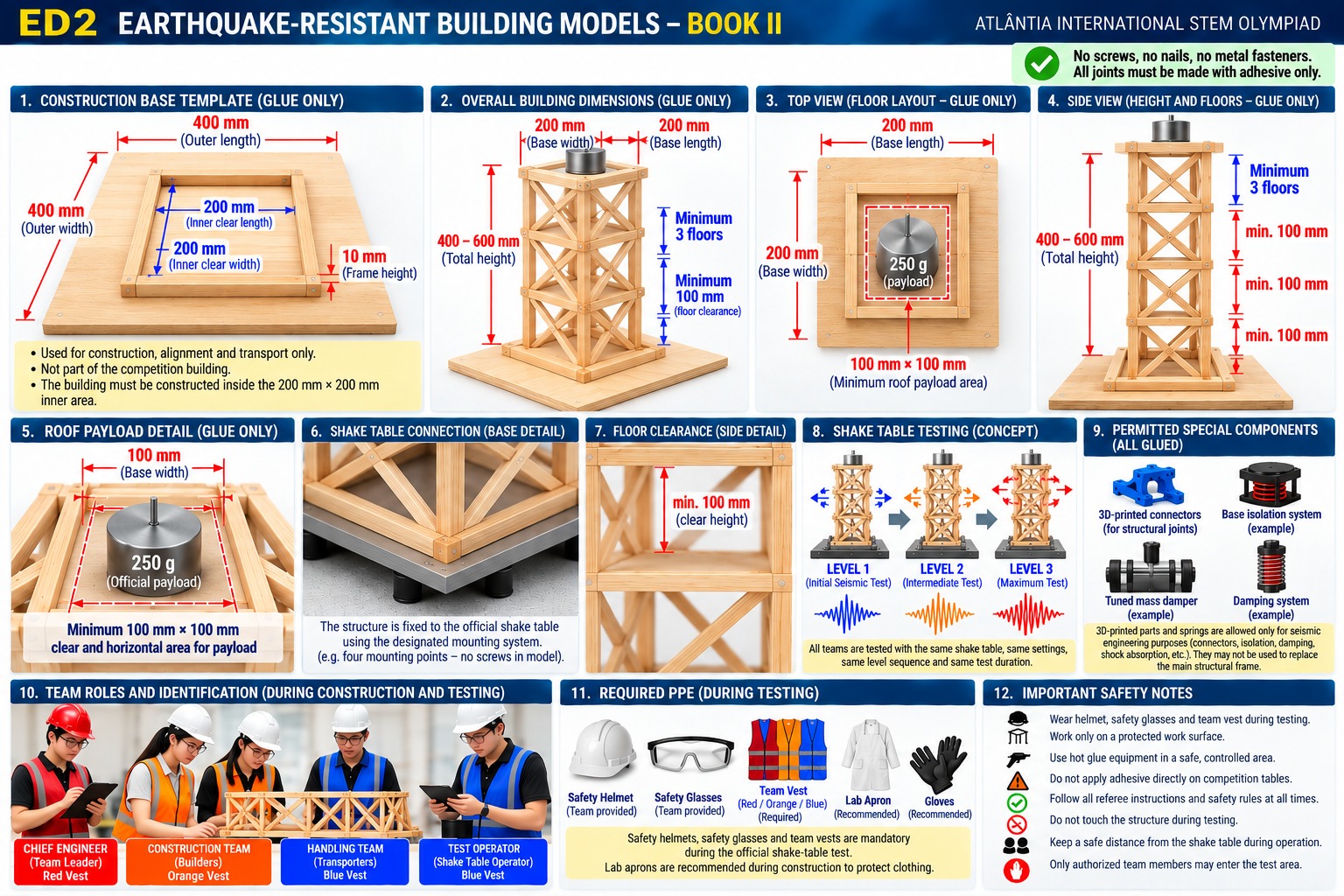
Teams are free to use 3D-printed custom connectors or springs to build seismic isolators, tuned mass dampers or shock absorber systems.
Payload Area
Provide an unobstructed roof area of at least 100 × 100 mm for the official 250 g payload. It is excluded from structural mass and must remain unattached: no glue, tape, ties, magnets or retaining locks.
Competition Setup
Seismic Wave Survival Mission
The competition is conducted on a professional shake table and consists of 3 stages.
On-site construction and inspection
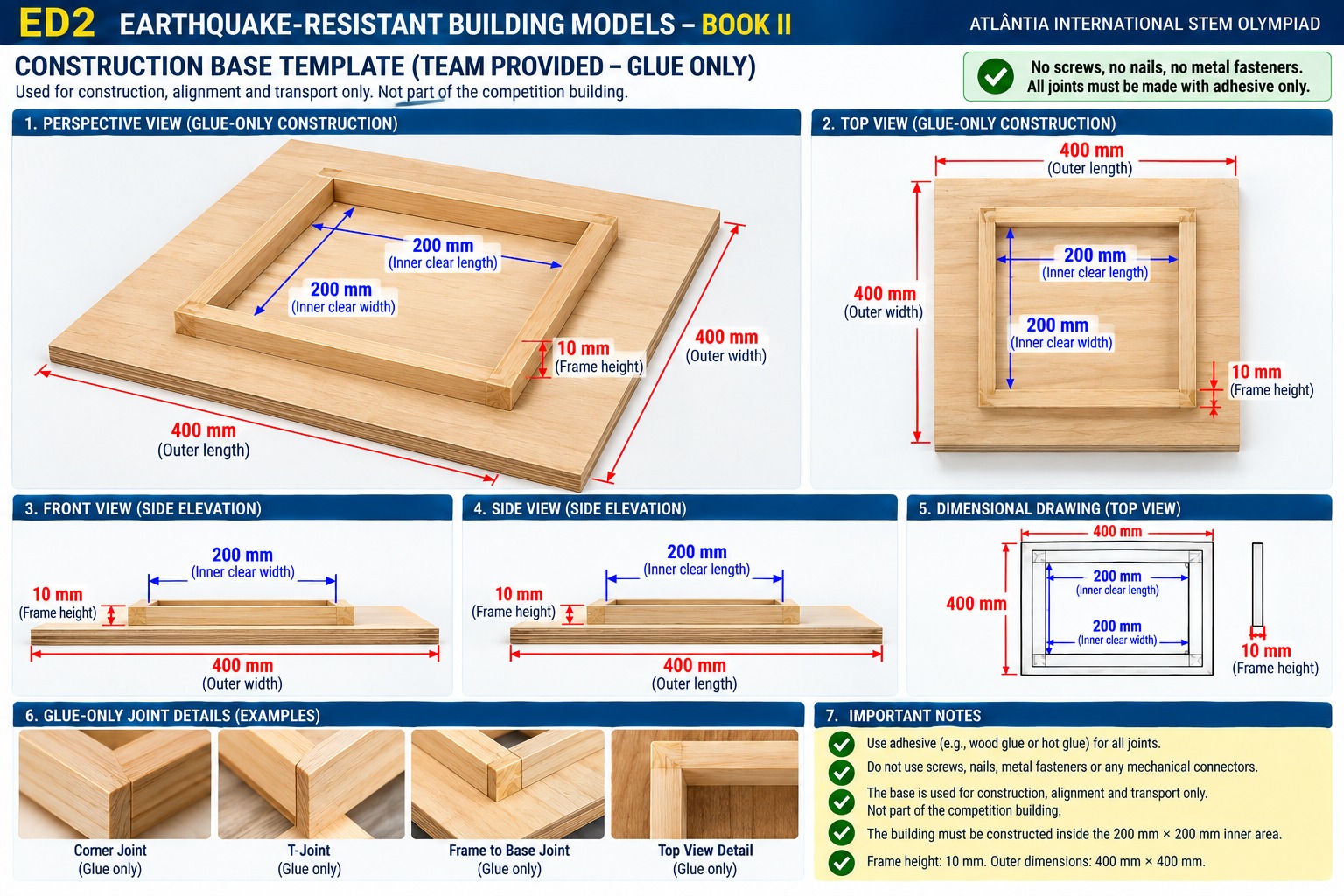
Students build the official structure during the announced construction period. Officials check materials, the 200 × 200 mm base, height, structural mass, floor clearances and compatibility with the official mounting arrangement.
Technical explanation (3 minutes)
Explain the design, bracing, damping or isolation choices and the improvements made through practice tests. Submit the predicted highest completed test stage before testing.
Progressive shake-table testing
The roof payload is placed and the structure proceeds through progressively stronger stages. Officials announce equal settings and durations for the competition level. Repairs between stages are not permitted.
Test Stage 1 — Initial
The first official shake-table setting establishes the initial performance result.
Test Stage 2 — Intermediate
Structures that complete Stage 1 face the more demanding second setting.
Test Stage 3 — Maximum
Structures that complete Stage 2 face the highest announced setting. No universal frequency or duration is prescribed.
Independent engineering awards
Seven awards recognise different achievements. Test performance is not converted into the former combined point-and-bonus system.
Best seismic performance
Rank by highest completed stage, then roof-payload retention, lower structural damage and lower official structural mass. Payload retention is recorded at the highest completed stage.
Engineering efficiency and prediction
Efficiency considers performance, material use and a justified seismic strategy. Prediction recognises the team’s advance assessment under the official award criteria; no automatic lightness bonus applies.
Design, aesthetics, craftsmanship and innovation
Separate jury awards recognise the development process, architectural and structural appearance, construction quality and purposeful engineering innovation.
Penalties & Disqualification
Payload loss
Loss of the roof payload is recorded separately and is not by itself structural failure. Officials stop testing if it creates an unsafe condition. Earlier completed stages remain valid.
Recorded separatelyDamage and unsafe continuation
Collapse, major structural failure, detachment or unsafe conditions may end testing. Minor cosmetic damage does not automatically mean structural failure. Repairs between stages are prohibited.
Official safety decisionMaterial and integrity violations
Only inspected and approved materials may be used. Prohibited construction assistance, concealed non-compliance or serious safety and integrity violations may affect award eligibility or cause disqualification.
DisqualifiedCompetition Rules & Guidelines
Review the official competition rules, evaluation criteria, project requirements and submission guidelines before preparing your project.
Participation implies acceptance of the official rulebook. All teams, mentors, and students are expected to read, understand, and comply with the rules.