Defense Technology Simulations
Develop and demonstrate a simulation that keeps a fictional dam’s water, energy and essential services operating through a disruptive incident.
Keep essential services working under pressure.
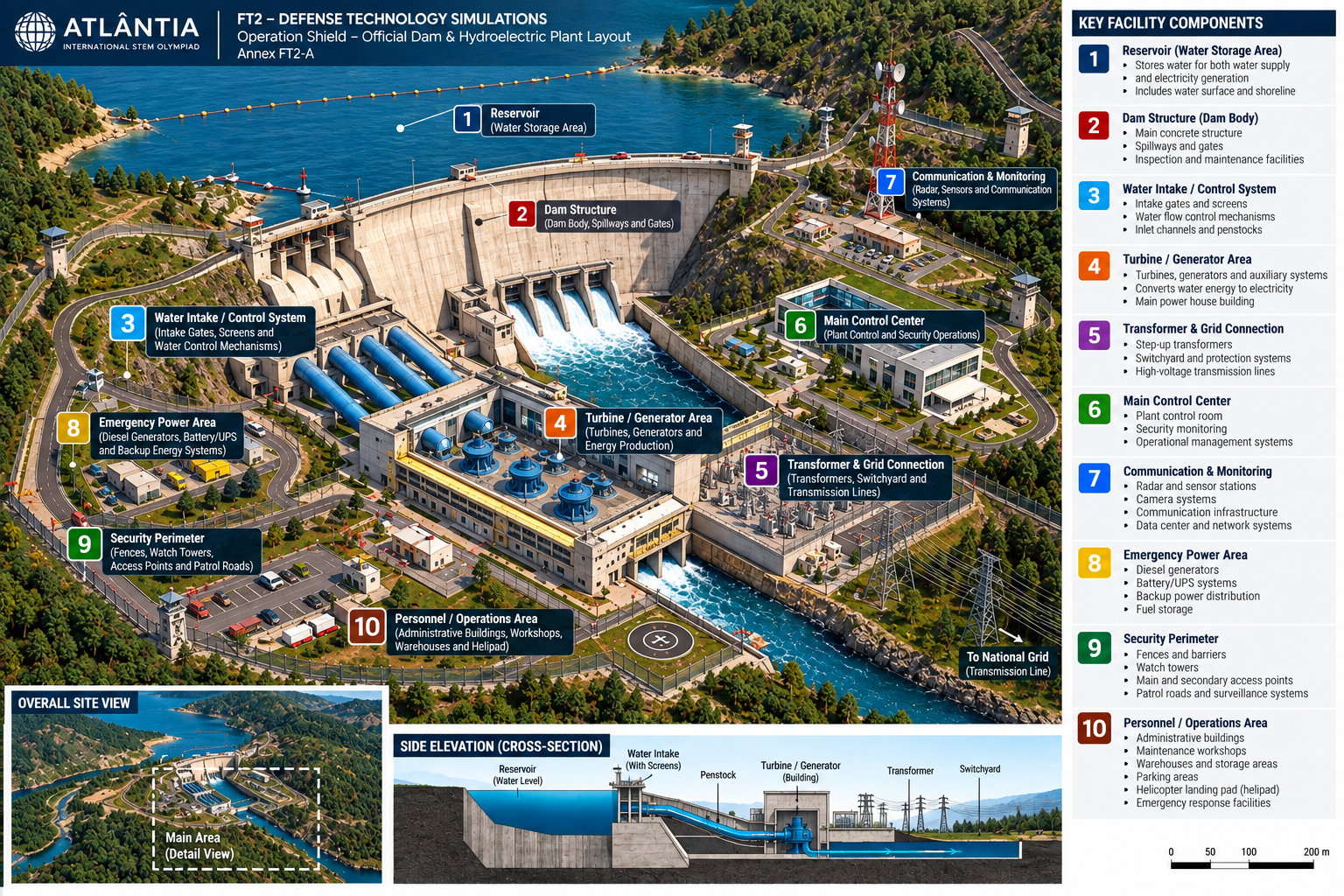
Operation Dam Shield asks your team to protect a fictional dam and hydroelectric facility in a digital simulation. Water control, electricity, communications and people depend on one another; the challenge is to keep essential functions working when an incident disrupts normal operation.
You design an integrated response and test it in a working simulation. During the jury session, you demonstrate what happens as incidents develop, how priorities change and how the facility continues operating if power, communications or sensors fail.
Explain what your solution can handle, where its limits are and what resources it needs. The jury values tested reasoning and clear evidence, supported by your report and project display. The shared scenario, technical reference and evaluation rubric are detailed in the official rulebook.

One facility, connected responsibilities
Develop an integrated response within the shared Operation Dam Shield scenario. These are related parts of the same project, not unrelated topic choices.
Water and energy dependencies
Explain how the dam, water intake, hydroelectric plant, turbines and grid connection depend on one another.
Monitoring and information
Model how monitoring information reaches the control centre and supports understandable decisions.
Continuity during disruption
Show what happens when communication, sensors or normal operating functions become unavailable.
Capacity and resilience
Test the common reference of 20 simultaneous aerial events and explain the system’s capacity and limitations.
Emergency power and priorities
Identify essential loads and show how backup power supports the functions that must continue.
People, cost and feasibility
Justify staffing, responsibilities, costs and the practical value of the proposed system.
Project Requirements
Simulation Tool
MATLAB, Python, NetLogo, AnyLogic or any similar simulation environment may be used. Open source is preferred but not mandatory.
Originality & Ethics
Projects must be entirely original; plagiarism results in disqualification. No real weapon designs or harmful applications are permitted.
Data & Scenarios
Use fictional or appropriately authorised information. Preserve the shared functional infrastructure reference; clearly identify team-defined assumptions, geometry, data and timescale. No common coordinate map or numerical dataset is imposed.
Competition Setup
Competition Stages
Teams go through a five-stage evaluation process with their projects. Each stage tests different dimensions of the project.
Understand and define the project
Identify the required infrastructure dependencies, the problem to solve and the assumptions your simulation will use. Follow the announced registration and submission process.
Simulation Development
Teams develop the simulation environment, code scenarios and run test simulations. Mentor support is provided at this stage.
Technical Report & Documentation
Submit the report, implementation and evidence required by the official rulebook and event notice. Identify the official software, model and dataset versions at the submission deadline.
Live Demo & Presentation
A typical session includes about 3 minutes of presentation, 3 minutes of live demonstration and 4 minutes of questions. The jury may request changed parameters or an explanation of a result.
Evaluation & Awards
The jury assesses the project using the 100-point category rubric and the registered competition level.
Evaluation Criteria
Ten criteria total 100 points. A physical prototype is optional; meaningful experimental evidence can support the evidence criterion.
| Evaluation criteria | Points |
|---|---|
| Problem Understanding and Critical Infrastructure Analysis | 10 |
| Solution Architecture and Protection Strategy | 15 |
| Simulation and Software Implementation | 15 |
| Capacity, Resilience and Failure-Scenario Performance | 15 |
| Engineering Feasibility and Energy Continuity | 10 |
| Innovation and Originality | 10 |
| Cost, Personnel and Price/Performance | 10 |
| Prototype / Experimental Evidence | 5 |
| Roll-up, Project Table and Technical Communication | 5 |
| Teamwork, Presentation and Technical Mastery | 5 |
Project Outputs
Working Simulation
A simulation environment that can be run live before the jury with adjustable parameters. Submitted together with source code.
Technical Report
Document the infrastructure, assumptions, architecture, simulation method, capacity tests, continuity, costs, results and limitations using the rulebook guidance.
Project display and recording
Prepare the project table and roll-up or poster for clear technical communication. Provide official student video evidence where required by the event.
Data & Result Files
Bring results, test logs, comparisons and supporting calculations that allow the jury to follow your claims.
Competition Rules & Guidelines
Review the official competition rules, evaluation criteria, project requirements and submission guidelines before preparing your project.
Participation implies acceptance of the official rulebook. All teams, mentors, and students are expected to read, understand, and comply with the rules.