Environmental Projects
Inspired by nature's engineering, design systems that can make you the architect of a cleaner and more sustainable world.
Notice a problem. Test a better solution.
Choose an environmental problem you can investigate: waste, water quality, air pollution, resource use or the health of an ecosystem. Develop a question or a practical improvement, then gather evidence to see whether your approach makes a difference.
Your project may use experiments, observations, a prototype, a model or a simulation. At the competition, explain the problem, show how you worked and present the results, including findings that did not match your expectations.
The jury looks for original student work, sound reasoning and a realistic account of environmental impact. You do not need an industrial product or an entirely new technology. Show what you contributed and what your evidence supports; preparation and evaluation details are in the official rulebook.
Thematic Focus Areas
These are examples, not a closed list. Choose a focused problem and evidence appropriate to your project and competition level.
Waste Management and Circular Economy
Going far beyond simply collecting and sorting waste, this area should be approached as a process based on the "zero waste" philosophy and the circular economy. Participants may work on systems that convert organic, industrial or electronic waste (e-waste) into valuable raw materials through biochemical processes, next-generation biomaterials to replace non-biodegradable plastics, or AI-powered robotic solutions that make waste sorting autonomous.
Water Treatment and Management
Innovative mechanisms that can directly address the global clean water crisis are of great importance. Among the strongest topics in this area are nanotechnological systems that detect and filter microplastics from oceans and drinking water, low-cost biological filtration designs that purify industrial wastewater with minimal energy consumption, or convert seawater for agricultural use.
Air Quality and Emission Control
Projects aimed at improving air quality should focus on technologies that will make cities breathable again. Innovative modules for direct air carbon capture and storage (CCS), smart filters that convert toxic gases from industrial chimneys into useful byproducts, or IoT-based sensor networks that map urban air pollution in real time and enable intervention can be developed.
Participation Rules
Develop an original student contribution and support its claims with suitable evidence.
Originality and Scientific Foundation
All submitted projects must be based on scientific foundations and be original. Projects that are direct copies of existing solutions will be eliminated.
Evidence appropriate to the claim
Use experiments, observations, measurements, prototypes, models or simulations suited to the question. Explain limitations and practical potential; industrial readiness is not required.
A method you can explain
Choose tools that help answer the question. AI, advanced sensors and other technologies are optional approaches, not entry requirements.
Sustainability
It is a fundamental requirement that the proposed system's own production and operating costs are also environmentally friendly and energy efficient.
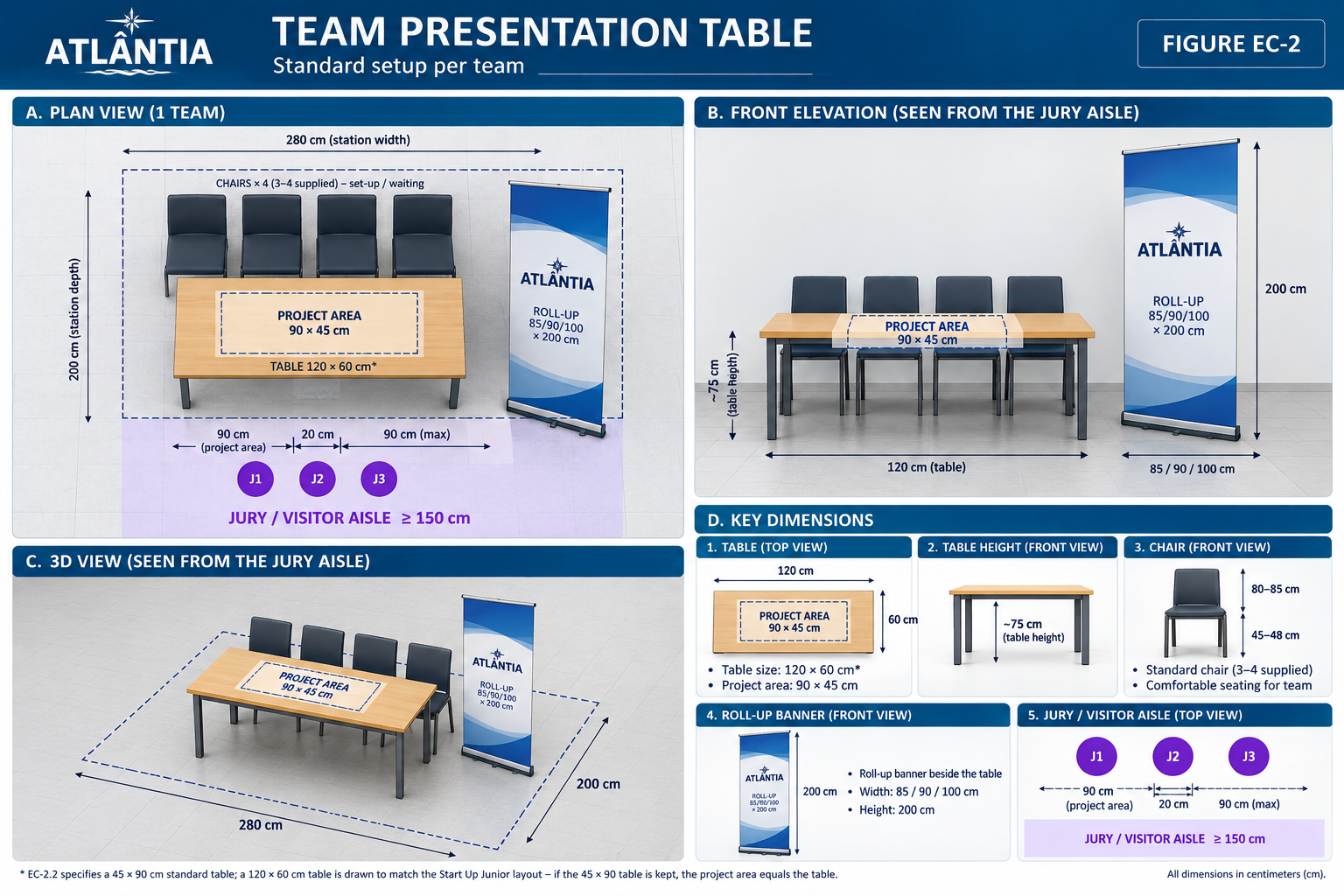
Project Presentation Area
Evaluation Criteria
The common Scientific Research & Innovation rubric totals 100 points. Expected technical depth follows the registered level.
| Criterion | Weight | Distribution |
|---|---|---|
| Innovation & Originality | 25 pts | |
| Scientific & Technical Competence | 25 pts | |
| Applicability & Scalability | 20 pts | |
| Sustainability & Impact | 15 pts | |
| Presentation & Defence | 15 pts | |
| Total | 100 pts |
Evaluation and Jury Process
Prepare an evidence-based project
Document the question, background, method, results and your own contribution. Prepare the report and supporting evidence specified by the rulebook and announced submission schedule.
Present, demonstrate and discuss
Give a 3–5 minute main presentation. Explain the project, show its evidence and answer the jury’s questions; the jury may extend the discussion. Technical depth is assessed at your registered level.
Competition Rules & Guidelines
Review the official competition rules, evaluation criteria, project requirements and submission guidelines before preparing your project.
Participation implies acceptance of the official rulebook. All teams, mentors, and students are expected to read, understand, and comply with the rules.