Bridge Design Models
Design aesthetically pleasing bridge prototypes with maximum durability using limited materials and weight budget, in accordance with engineering principles.
Build a bridge. Test your thinking.
How much can a light wooden bridge carry? Your team explores different shapes and connections, builds practice models and uses the results to improve a design. The aim is to understand why a structure works, not simply to make it look strong.
At the competition, students construct the official bridge on site, explain their design and predict its performance. Officials inspect the finished model before a controlled load test reveals how well it carries weight.
Strength is only one part of the experience. Design development, efficiency, appearance, craftsmanship, innovation and prediction are recognised through separate awards. Bring evidence of your experiments and improvements; material rules, inspection requirements and testing procedures are set out below and in the official rulebook.

Bridge Model Specifications & Limits
Allowed Materials
Use whole, natural, uncoated wooden craft sticks in the permitted size range. Cutting, drilling, sanding and reshaping are prohibited. Low-temperature hot-melt adhesive is permitted for joining sticks at the protected construction workstation.
Prohibited Materials
No pre-glued modules or pre-built structural sections. Metal, plastic, fibre, string and epoxy reinforcement are prohibited unless expressly authorised by an official clarification. Adhesive must not become a structural beam or reinforcement mass.
Competition Setup

From on-site construction to load testing
Prepare and test prototypes before the event; students build the official bridge during the announced construction period.
Build, document and inspect
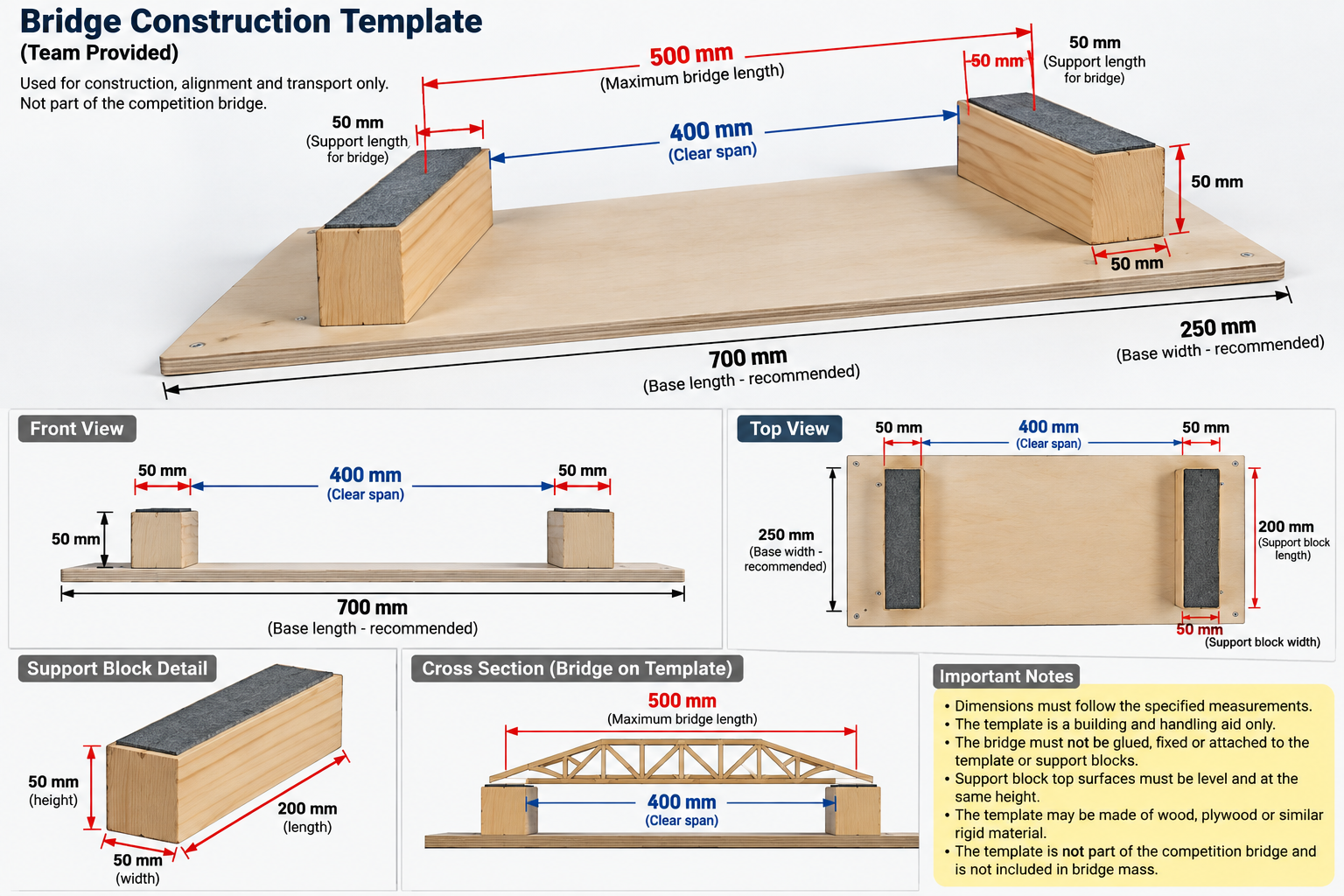
Construct on a protected workstation using approved materials. Officials check dimensions, mass, the 400 mm support span, the continuous 70 × 70 mm deck clearance and the loading interface.
Explain the design and submit a prediction
Show the development process, prototype tests and improvements. Submit a load prediction before testing; it cannot be changed afterwards. Record the finished bridge before destructive testing.
Load Test
A designated student operator applies load under referee supervision. The qualifying load is 5.00 kg; the official test is capped at 15.00 kg. Follow the official load-test sheet and required helmet, eye protection and role-vest procedure.
Independent engineering awards
Seven awards are evaluated separately; there is no combined 100-point bridge score.
Measured performance, efficiency and prediction
Best Performance uses the official supported load. Engineering Efficiency uses supported load divided by bridge mass. Engineering Prediction compares the submitted prediction with the official recorded result.
Engineering design and innovation
Engineering Design recognises research, prototypes, testing and improvement. Engineering Innovation recognises an original, justified structural solution using permitted materials.
Aesthetics and craftsmanship
Bridge Aesthetics considers form, proportion and structural elegance. Craftsmanship considers joints, alignment, precision and clean assembly. These are separate from strength.
Penalties & Disqualification
Inspection and correction
A dimensional, mass, clearance or loading-interface failure may be corrected only when officials permit it under the construction and inspection rules. There is no automatic per-centimetre point deduction.
Official inspectionTest interference
Touching or stabilising the bridge, supporting the loading apparatus or making unauthorised modifications can invalidate performance-related awards without automatically removing unrelated award eligibility.
Affected result invalidatedSerious integrity or safety violations
Pre-built sections, prohibited reinforcement, mentor construction, falsified evidence or serious safety violations may lead to category disqualification.
DisqualifiedCompetition Rules & Guidelines
Review the official competition rules, evaluation criteria, project requirements and submission guidelines before preparing your project.
Participation implies acceptance of the official rulebook. All teams, mentors, and students are expected to read, understand, and comply with the rules.