Smart City Systems
Design a physical Smart City prototype that enhances urban quality of life using sensor data processing, autonomous decision-making and renewable energy management principles.
A small city. Real decisions.
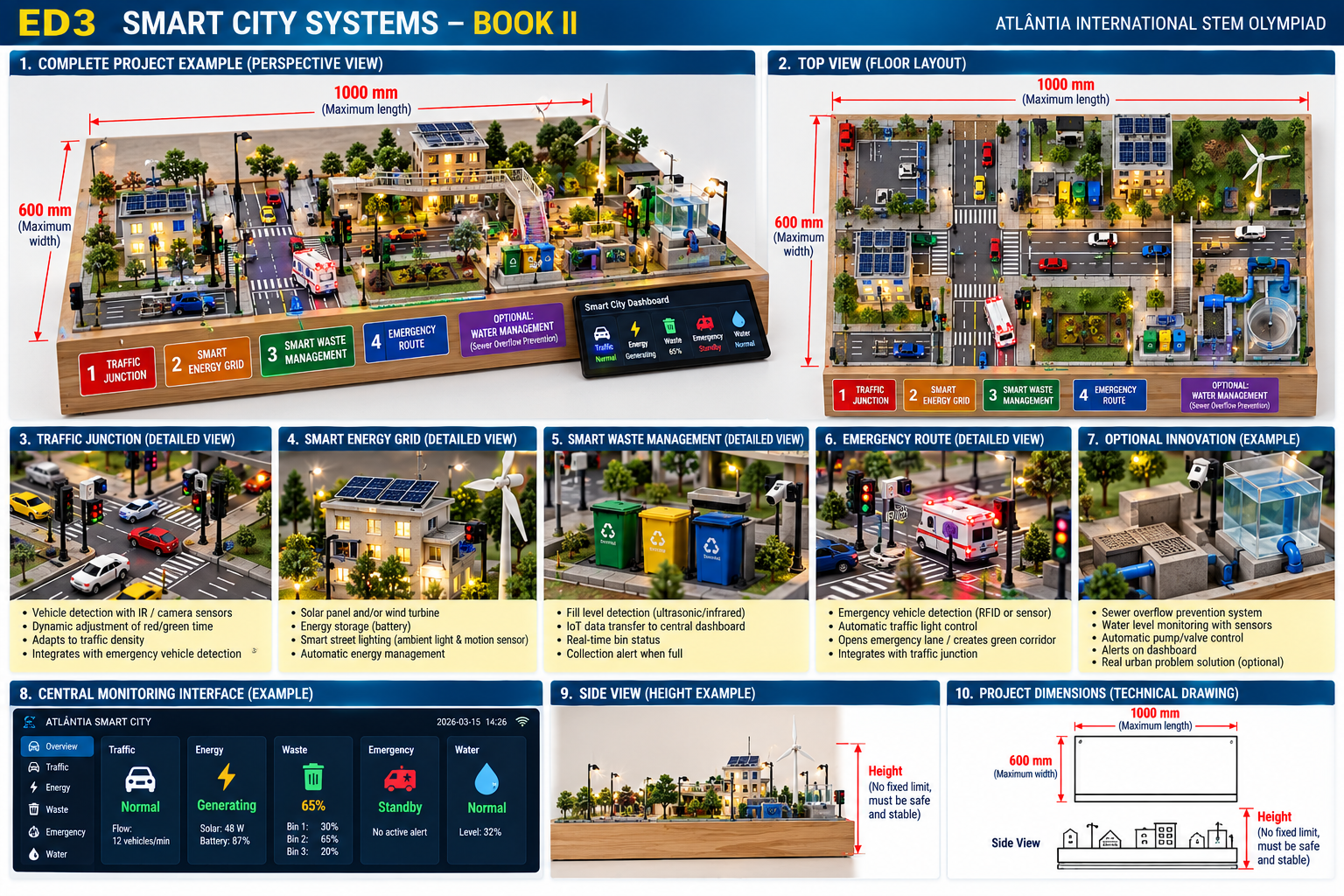
Build a city model that responds to what is happening around it. Traffic should react to vehicles, lighting should respond to conditions, waste systems should report when attention is needed, and an emergency vehicle should be able to request a clear route.
Your team brings selected city services to life using sensors, student-written logic and working outputs. At the event, you explain the system and demonstrate how it reacts when the jury changes the situation. A decorative model or a repeating light sequence alone does not show this decision-making.
The challenge is to connect useful services into a reliable working prototype and explain how they could improve urban life. Choose and prepare the required subsystems using the official rulebook; the technical sections below cover the model limits, live tests and evaluation.

City Model Specifications & Limits
Required Subsystems (At Least 3 Must Be Active)
Autonomous Traffic Junction
A sensor-based system (IR or camera-based) that dynamically adjusts red/green light durations according to vehicle density.
Smart Energy Grid
A system that stores energy during the day (solar panel/wind turbine) and autonomously activates smart street lights (ambient light and motion sensitive) at night.
Smart Waste Management
IoT-based smart waste bin systems that measure fill level and send data to a central interface/display.
Autonomous Emergency Route
Detect an approaching emergency vehicle, stop conflicting traffic and provide a prioritised green route using the selected sensor and control system.
Hardware & Software
Use programmable electronic control that students can explain. Arduino, Raspberry Pi, ESP32 and similar platforms are examples, not a required brand. Ready-made systems without meaningful student programming or engineering do not satisfy the task.
Competition Setup
Demonstrate a responsive city
Declare exactly three of the four required subsystems for scoring before the live functional test. Building a fourth does not increase the subsystem maximum.
Technical Infrastructure Review
Referees inspect wiring quality, sensor placements, soldering and microcontroller connections for aesthetics and safety.
Project explanation (3–5 minutes)
Explain the urban problems, sensor inputs, decision logic and resulting actions. Demonstrate student ownership of the wiring, code, tests and improvements.
Live Simulation Tests
Real-time scenario tests are applied.
Input, decision and action
Officials test the selected subsystems through changed conditions. Show how real input is processed into an autonomous physical or digital response.
Integrated operation
Demonstrate reliable coordination between the selected services. Fixed light loops and decorative components alone do not count as active subsystems.
Scoring System
Evaluation is based on a total of 100 points.
Three selected active subsystems
Each selected subsystem is worth 20 points: input detection, processing and decision, autonomous action and functional result. Official ranking requires three active required subsystems.
Hardware and coding quality
Construction, wiring, code structure, sensor suitability, reliability and maintainability.
Integration and engineering quality
Architecture, data flow, coordinated control, testing, improvement and stable operation.
Project defence and applicability
Student understanding, technical answers, documented development and practical urban usefulness.
Penalties & Disqualification
Manual Intervention
Unauthorised manual control can invalidate the affected automatic-action/result points. Do not also deduct for the same incident when those points are already lost; otherwise the stated 15-point deduction applies.
No double deductionSystem Crash / Freeze
A complete crash during a subsystem test gives that subsystem 0/20. Other independently completed subsystem results remain valid.
Test Score ZeroReady-Made Module Usage
A ready-made system without meaningful student engineering may be rejected or have its score invalidated; serious cases may lead to disqualification.
DisqualifiedCompetition Rules & Guidelines
Review the official competition rules, evaluation criteria, project requirements and submission guidelines before preparing your project.
Participation implies acceptance of the official rulebook. All teams, mentors, and students are expected to read, understand, and comply with the rules.