Explore and deploy
Leave the base autonomously, traverse the designated exploration route and deploy three scientific instrument modules. The rover cannot receive manual directional commands in Zone A.
Explore a planetary outpost with a rover, a mission plan and a team ready to adapt.
Imagine your team is supporting a scientific base on a distant planet. Your rover explores unfamiliar terrain, deploys instruments, collects a geological sample, activates solar infrastructure and establishes communications before returning to base.
The field combines autonomous exploration with a zone where permitted manual or hybrid control can help complete the work. Teams must balance a reliable route with decisions about which missions to attempt and how to handle the sample and energy information set for that run.
The challenge grows with the student's level. Junior teams use a ground rover; Challenger adds a protected micro-drone for the communications mission. Elite teams also demonstrate information travelling from the drone to the rover. These profiles change the mission, while awards remain separated by registered education level.
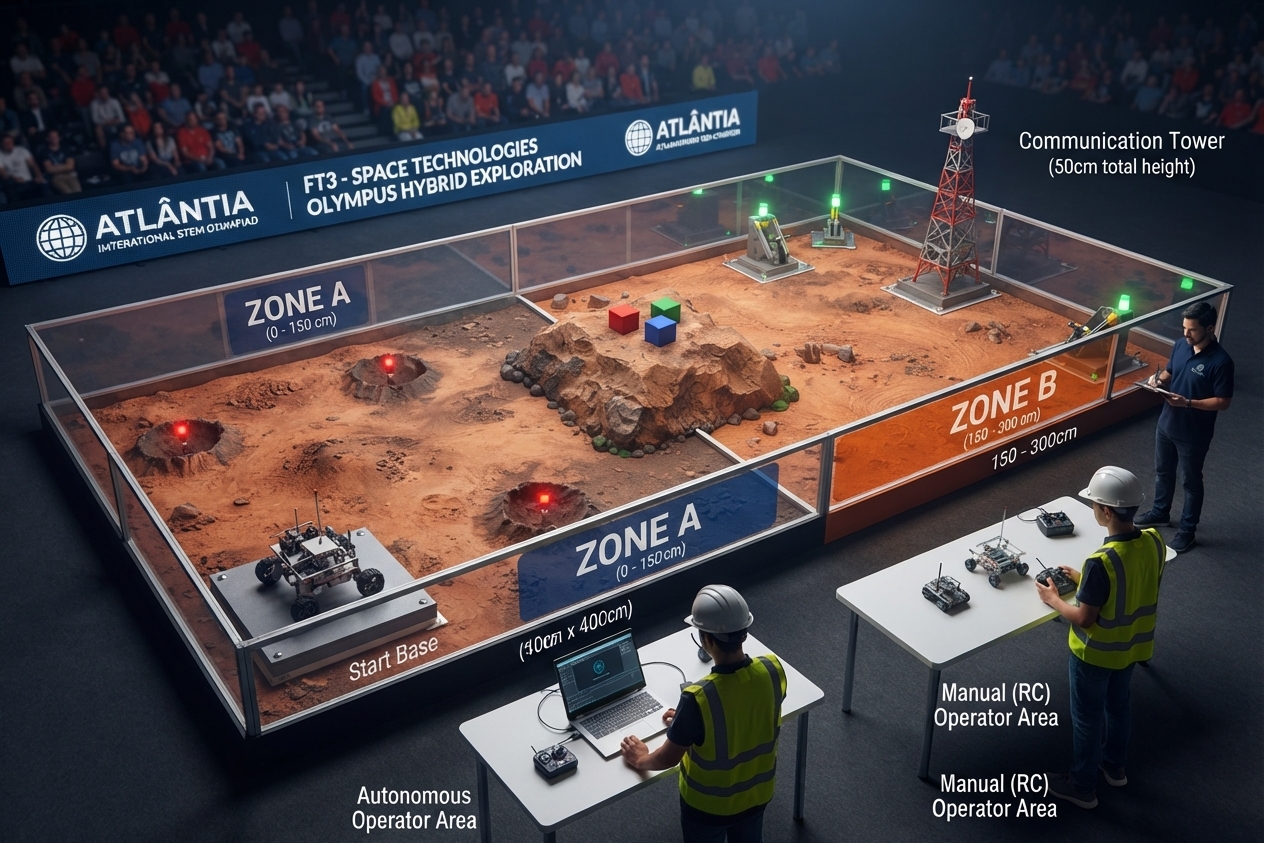
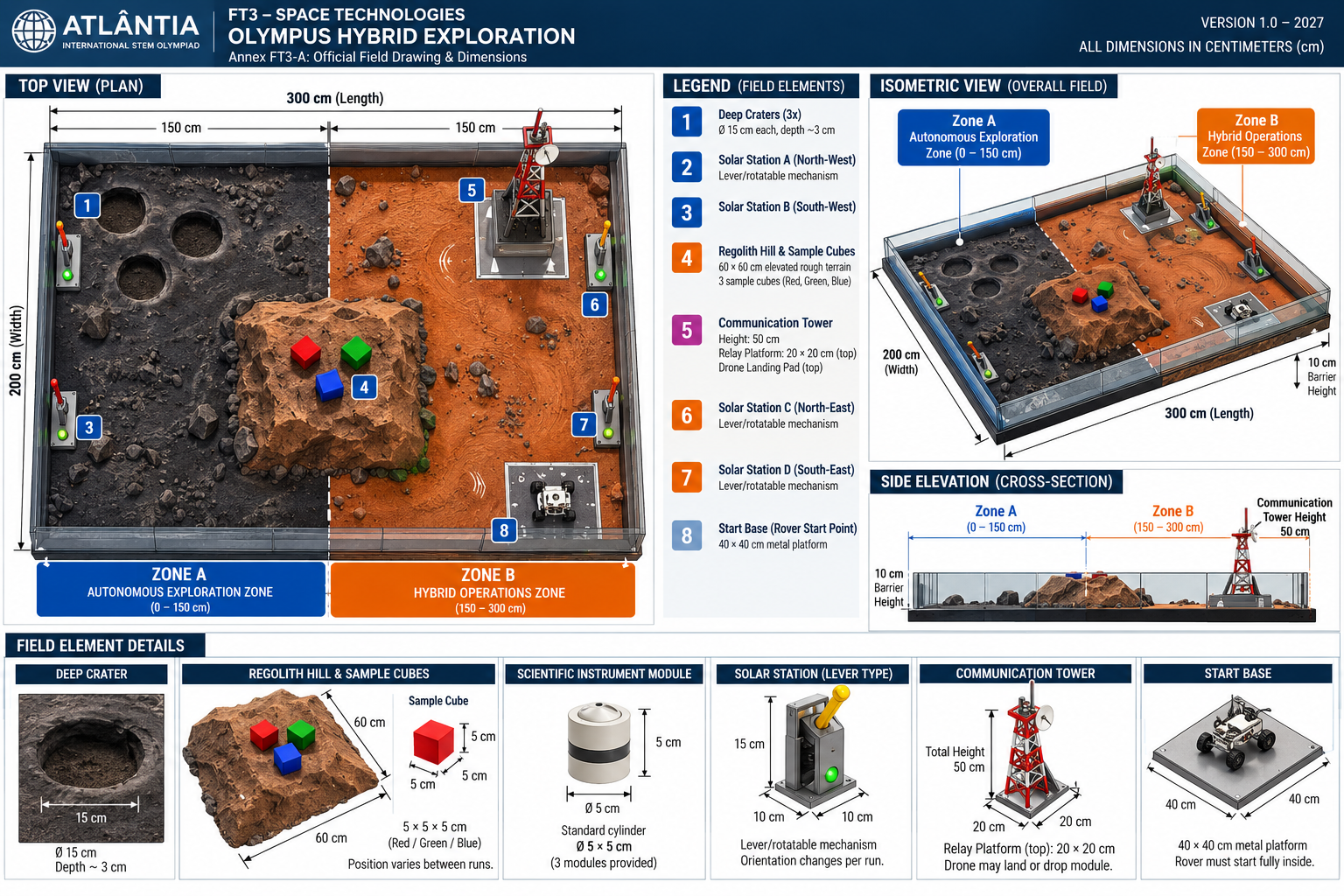
Leave the base autonomously, traverse the designated exploration route and deploy three scientific instrument modules. The rover cannot receive manual directional commands in Zone A.
Identify the requested sample, bring it to the research laboratory and activate the solar station in the correct direction. Referee-set values make sensing and preparation important.
Junior delivers a module to the ground relay dock. Challenger deploys it by protected micro-drone. Elite additionally reads the mission marker from the drone and transfers its content to the rover without manual entry.
Bring the rover completely back to base. Teams may choose mission order where no prerequisite applies. The clock continues through permitted recoveries and control-mode changes.
| Task | Points |
|---|---|
| Autonomous exploration | 15 |
| Instrument deployment | 20 |
| Sample mission | 20 |
| Solar array mission | 15 |
| Communication relay | 20 |
| Return to base | 10 |
| Completion time bonus | Up to 10 |
A run scores up to 100 mission points plus a time bonus of up to 10, minus penalties. The time bonus applies only when all required missions are fully completed: one point per complete ten seconds remaining. The best two runs are added. Up to three referee-authorised Recovery Cards may be used per run, each costing 5 points; a further required recovery ends the run.
The rover must fit the starting cube at inspection and at each start; safe mechanisms may extend afterwards. The micro-drone's approximate 20 × 20 × 10 cm size is guidance, not a mandatory size limit.
Drone operations take place only inside the common protected drone field. The drone operator wears eye protection. Propellers must be fully protected and powered systems must demonstrate an emergency stop.
Rover, Drone and Mission/Guidance Operators perform the student roles appropriate to their profile. No mentor controls vehicles or handles mission objects during a run. Elite data must originate from the drone, not manual typing.
Rehearse a complete mission plan for your education level and verify safe transitions between the two control zones. Read the official rulebook and its field/technical-sheet annexes for exact interfaces, marker presentation, scoring and tie-breaks. Participation implies acceptance of those rules.
Review the official competition rules, evaluation criteria, project requirements and submission guidelines before preparing your project.