Read the demand
The referee sets a demand matrix before the run. During AUTO, read the optical signal towers, identify the demand, select the correct energy type and deliver it without directional input.
Read the city's energy needs, deliver the right resources and reduce its carbon load.
In EcoGrid, your robot becomes the energy manager of a future smart city. Solar, wind and hydro energy are represented by different cubes. The robot reads the city's demand signals and decides which resource belongs at which hub.
The run starts with an autonomous period, so the robot must sense and act without directional help. A student then takes control for the remaining mission: delivering energy, removing carbon blocks and planning a return to the charging station before the clock ends.
Success depends on more than carrying many cubes. Teams have to match the resource to the demand, choose a useful delivery strategy and demonstrate an explainable AI function. The challenge brings together sensing, manipulation, autonomous decisions and coordinated student operation.
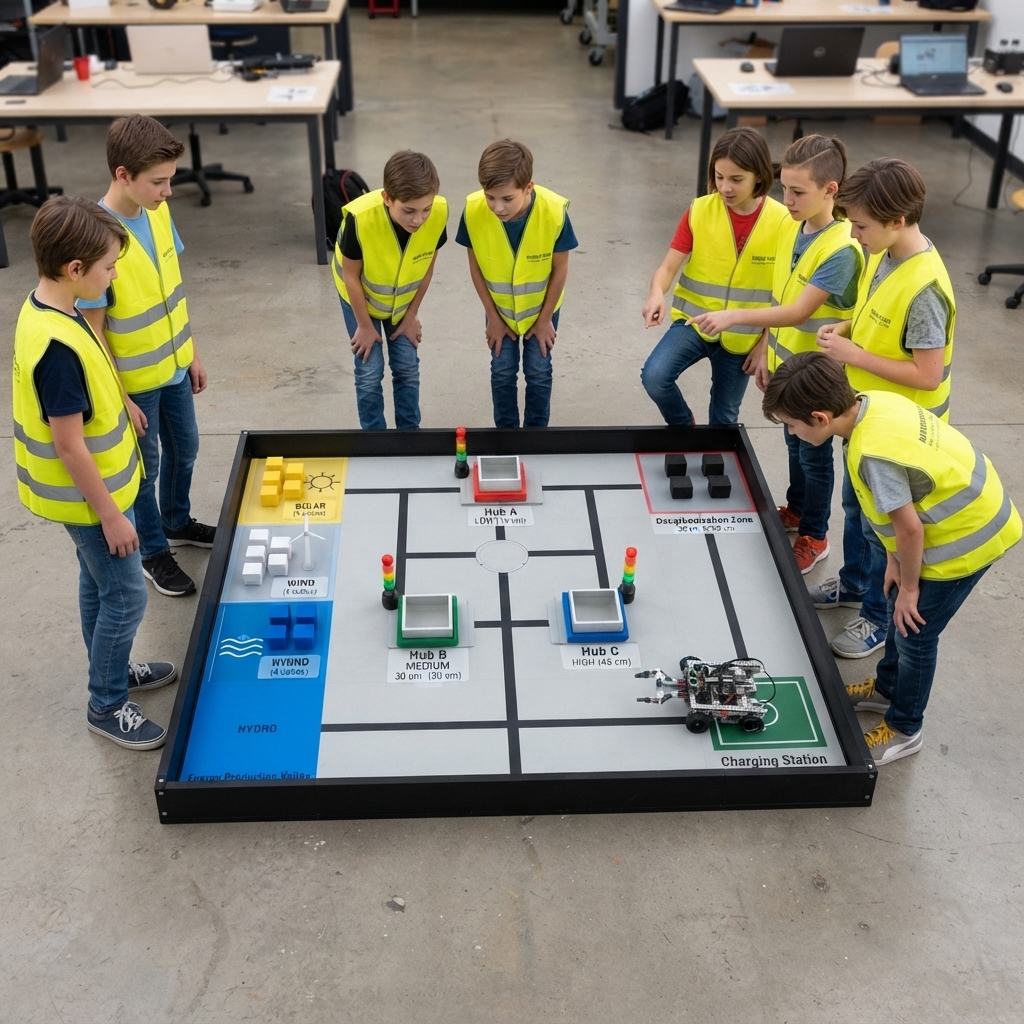
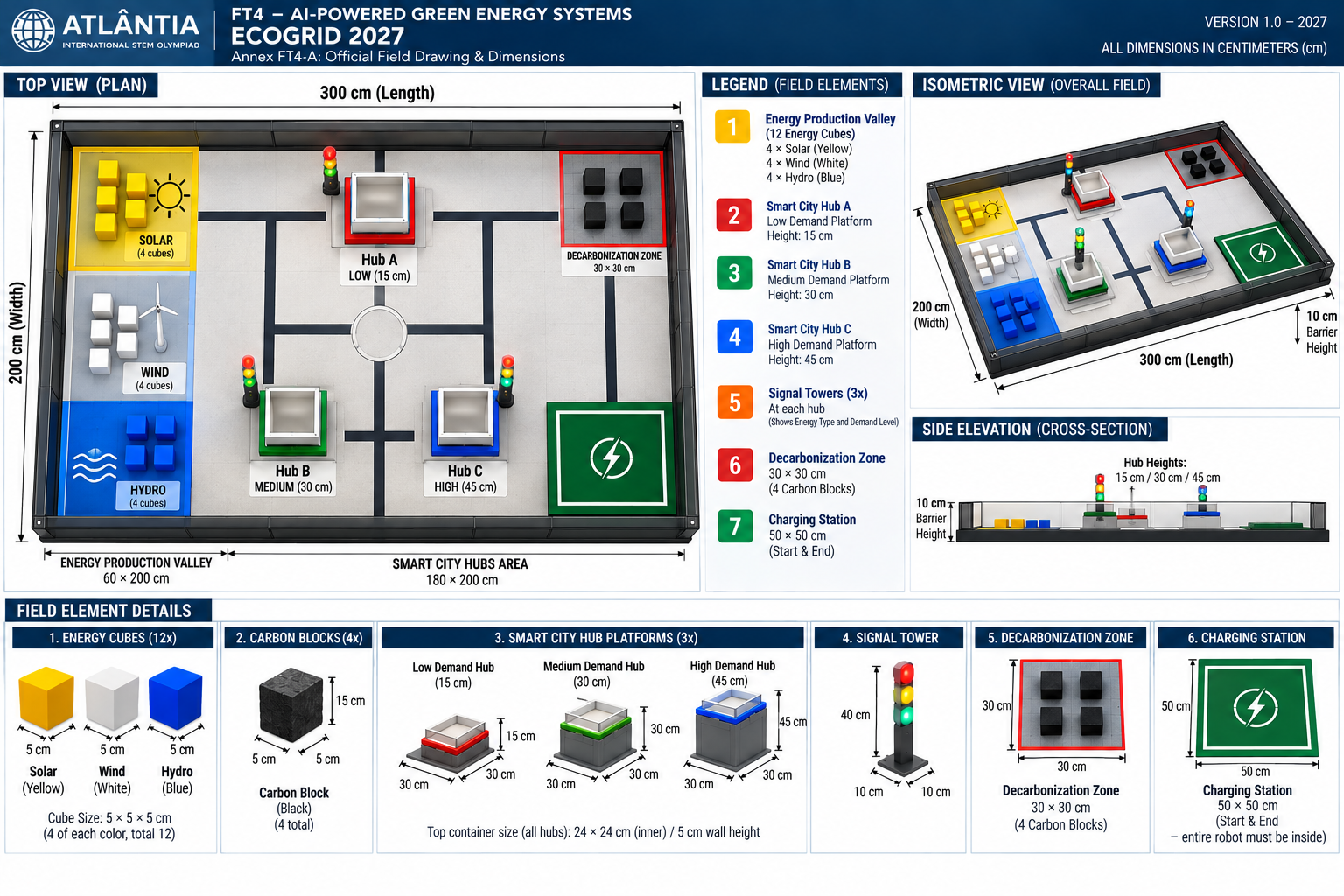
The referee sets a demand matrix before the run. During AUTO, read the optical signal towers, identify the demand, select the correct energy type and deliver it without directional input.
After the TELEOP signal, the designated student operates the robot. Match each delivery to the hub's demand and select a strategy across the low, medium and high platforms.
Move carbon blocks completely into the Decarbonization Zone. Objects must be released and meet the scoring conditions; throwing or high-energy launching is prohibited.
The last ten seconds are the endgame within TELEOP, not extra time. Finish stationary with the whole robot inside the Charging Station at the final signal.
| Task | Points |
|---|---|
| AUTO: recognition, selection, arrival and delivery | Up to 60 |
| Correct cube to low / medium / high hub | 10 / 20 / 30 each |
| Carbon block removed | 15 each; up to 60 |
| Full stationary endgame parking | 25 |
| Wrong energy type / carbon block in a hub | −5 / −15 each |
Each cube scores once, and a cube credited in AUTO cannot score again in TELEOP. Net run scores cannot be negative; the two highest are added. The maximum obtainable score depends on the official demand matrix, which is identical for directly compared teams in the same level and stage. Ties first consider penalties, then parking completion time and the remaining rulebook criteria.
An explainable AI sensing, classification, prediction or decision component must contribute to the mission. Fixed IF/THEN logic alone does not meet that requirement; conventional control may work alongside AI. Core operation needs no internet connection.
Only students perform the Robot, Technical, Mission/Strategy and Video Operator functions. Every run must be recorded by the designated student from an approved position.
Inspect batteries, moving mechanisms and electrical protection. Team-built hardware is limited to 12 V DC; an external commercial computing device may use its certified supply. Manual directional input during AUTO cancels the autonomous points.
Practise recognising demand before delivery, verify each released cube remains in its intended container, and reserve time for parking. All teams, mentors and students must read, understand and comply with the official rulebook and its technical-sheet annex.
Review the official competition rules, evaluation criteria, project requirements and submission guidelines before preparing your project.