Observe and prepare
In Round 1, field observation, calibration, programming and testing are included in the five-minute clock. Up to three autonomous starts are allowed; the saved valid attempt and its victim state must remain linked.
One robot. Two rescue stages. A team that adapts under pressure.
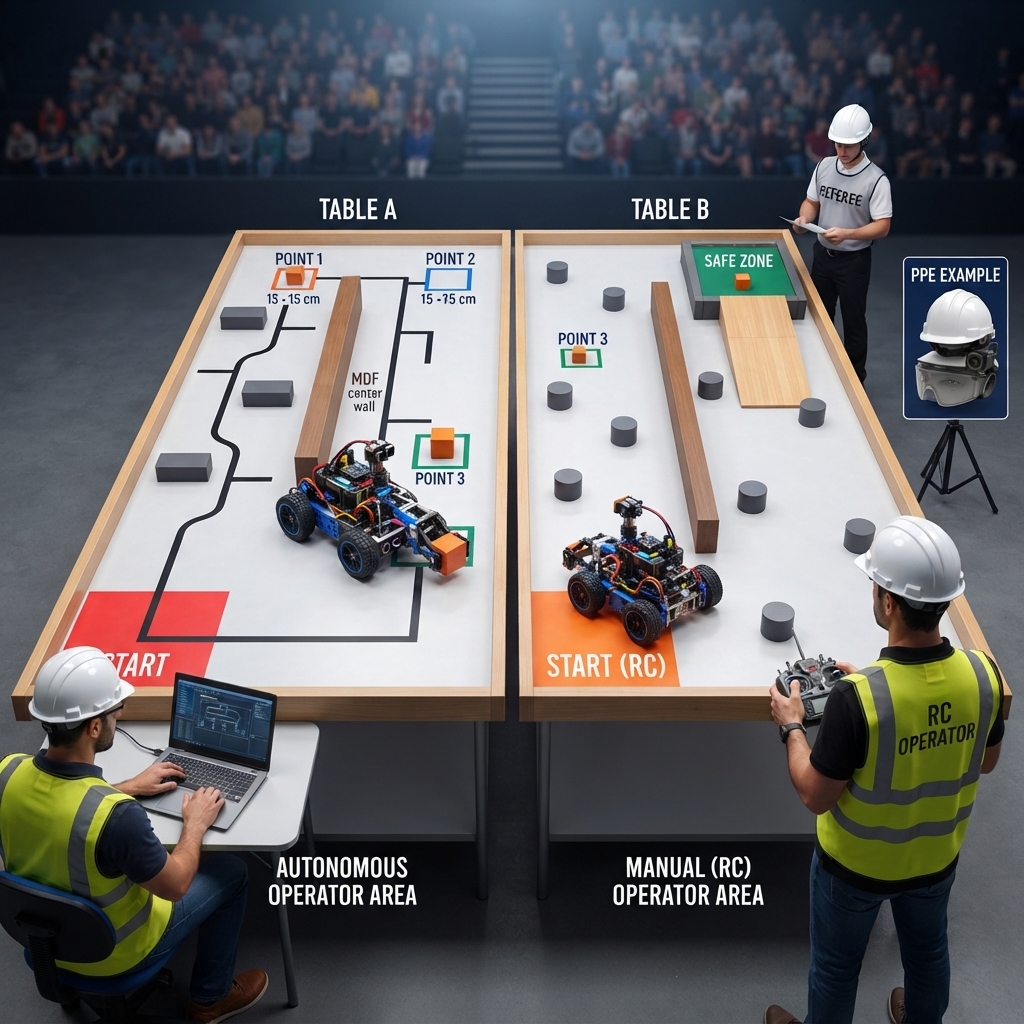
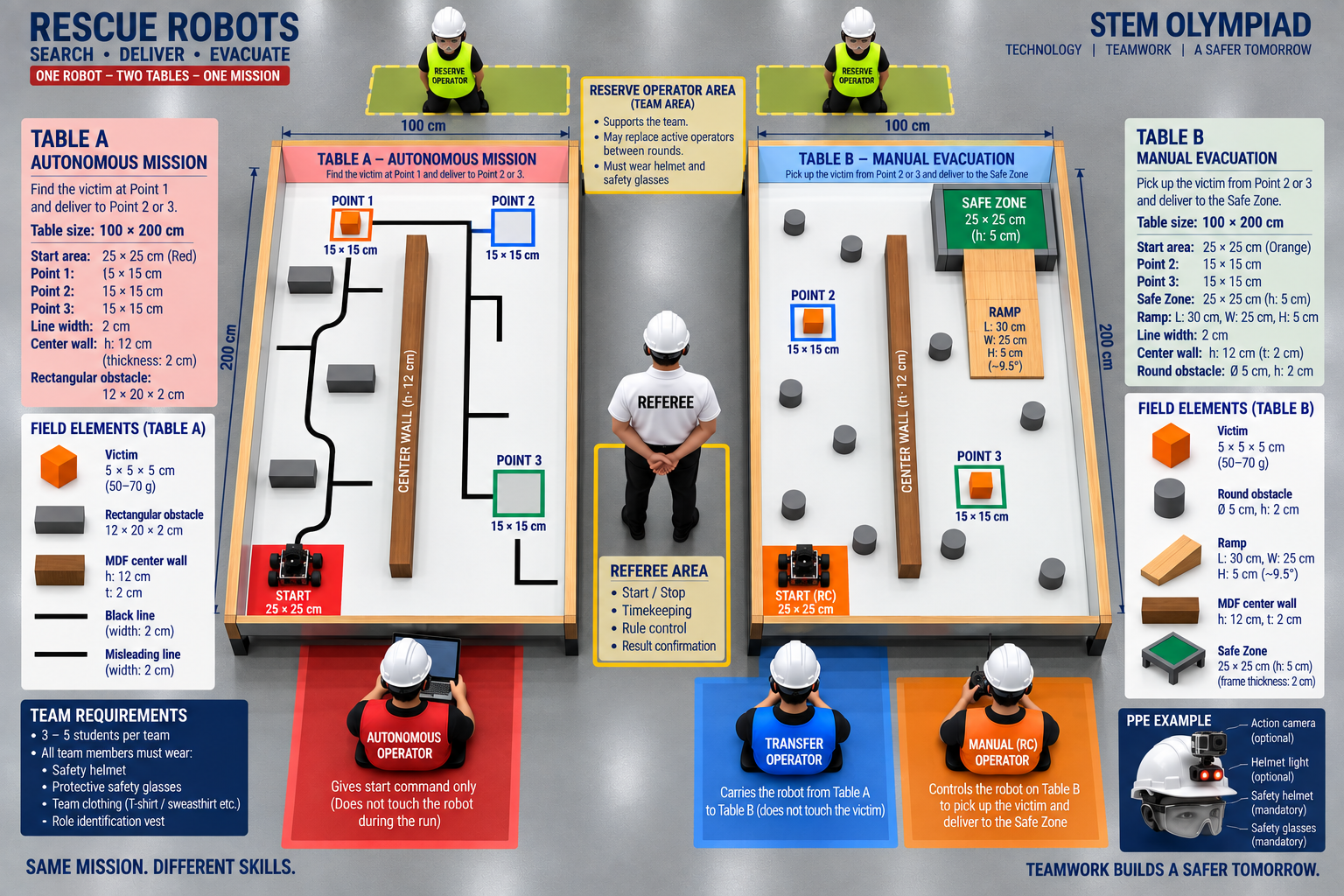
Your team sends a robot into a simulated rescue scene. First it must find and move a victim on its own, using the route and its sensors to decide what to do. Choosing the more demanding delivery point can earn more points, but the rescue must remain reliable.
The mission then changes. After the referee authorises a transfer, students move the same robot to a second table and a teammate takes remote control. The goal is to collect the victim, reach the raised safe zone and, if possible, return to the start. A simple ramp approach and a lifting mechanism offer different strategies.
This is a practical teamwork challenge as much as a programming task. Students observe, calibrate, adapt their mechanisms and carry out every competition operation themselves. The first round includes preparation time; the later rounds test whether the team's solution can perform again under a tighter clock.
In Round 1, field observation, calibration, programming and testing are included in the five-minute clock. Up to three autonomous starts are allowed; the saved valid attempt and its victim state must remain linked.
Leave the red start, reach Point 1, remove the victim and deliver it to Point 2 or Point 3. The controller is not touched during this stage. Rounds 2 and 3 allow only one autonomous start.
Wait for STOP – TRANSFER. The Transfer Operator moves the robot; only the referee moves the victim. After authorisation, the Manual Operator drives to the victim and evacuates it via the ramp or by direct lifting/carrying.
A fully released victim in the Safe Zone completes the evacuation. Returning the robot to the manual start earns additional points. The referee records both stages and penalties together.
| Task | Points |
|---|---|
| Table A via Point 2 / Point 3 | Up to 50 / 65 |
| Table B via ramp / direct lift or carry | Up to 55 / 65 |
| Highest possible round score | 130 |
| Best two rounds combined | 260 |
Point 2 and Point 3 deliveries are alternatives, as are ramp and direct evacuation scores. Final ranking adds the two highest net round scores. Ties first compare the autonomous scores of the counted rounds, then the best round and the remaining rulebook criteria.
Active roles are Autonomous Operator, Transfer Operator and Manual Operator; reserves may replace them between rounds. Students perform all calibration, programming, repair and operation from inspection onwards.
Safety helmets and eye protection are mandatory for all students in the competition area. Role vests must remain visible. The same electrically powered robot must support both control modes.
No repair or reprogramming is allowed during transfer. Unauthorised touching, controller use during Table A, destructive operation and unauthorised restarts can end or invalidate an attempt. Read the complete penalty table before practising.
Practise the full sequence with your assigned roles, including the referee-controlled transfer. Test a dependable victim release and safe-zone placement, not only navigation. Participation implies acceptance of the official rulebook; all teams, mentors and students must read, understand and comply with it.
Review the official competition rules, evaluation criteria, project requirements and submission guidelines before preparing your project.