Mechanical System Designs
Design a functional autonomous machine using kinematic chains, gear ratios, crank systems and linkage mechanisms.
Make motion do useful work.
Your team builds an automatic machine that moves and sorts a collection of objects. You decide how parts will travel through the mechanism and how the machine will place them in the correct destinations without someone guiding each movement.
At the competition, you explain the mechanism, declare your sorting approach and demonstrate it with the official objects. The machine must handle them reliably and without damage. Testing often reveals the small details that matter: a gripping surface, a slipping belt or a joint that needs better alignment.
The jury considers successful sorting, mechanical design and purposeful innovation. A simpler mechanism can be a strong solution when it works well and the team can explain it. Attempt limits, object arrangements, dimensions and scoring are detailed below and in the official rulebook.

Mechanical System Specifications & Limits
Allowed Materials
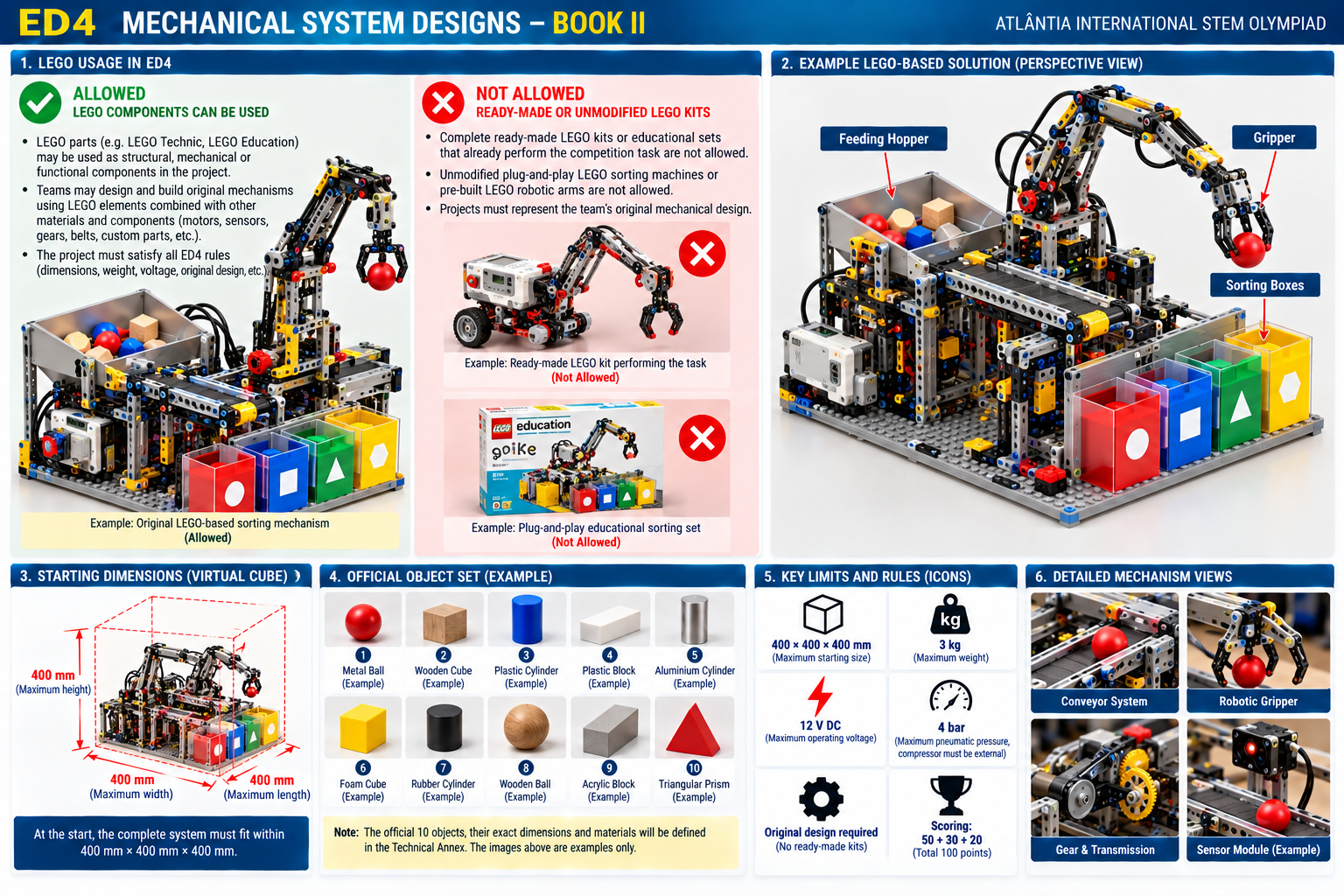
Aluminium, plexiglass, wood, carbon fiber, 3D printer filaments (PLA/PETG/ABS) and all standard mechanical fasteners (bearings, gears, belts, pulleys) are permitted.
Prohibited Elements
Direct use of industrial ready-made robotic arms, toy chassis or unmodified closed-box assembly kits is prohibited. The original design of the mechanism must belong to the team.
Actuators & Power
Servo motors, stepper motors or DC geared motors may be used. Maximum operating voltage is limited to 12V DC. If a pneumatic system is used, the compressor must be external and system pressure must not exceed 4 bar.
Competition Setup
Autonomous Sorting & Logistics Challenge
Sort the ten official objects automatically. There are two attempts of up to three minutes; the better complete attempt counts.
Measurement & Referee Approval
The system's dimensions, weight and safety standards (no exposed dangerous cables, sharp metal, etc.) are inspected.
Technical Defense (3 Minutes)
The team spokesperson presents the torque/speed calculations, degrees of freedom (DoF), gear and linkage choices used in the mechanism to the VIP jury panel in a technical presentation.
Live Performance Test
Declare a sorting rule and an object-to-output mapping before the attempt. The official set includes cubes, cylinders, spheres and rectangular blocks in red, blue and yellow. Sort without damaging the objects; do not combine results from separate attempts.
Scoring System
Evaluation is based on a total of 100 points.
Sorting & Task Success
Each correctly sorted, undamaged object earns 5 points, up to 50. The better attempt is selected using net task performance; penalties from that counted attempt are deducted once.
Kinematic & Mechanical Design Quality
Motion fluidity, friction minimization, backlash reduction and engineering craftsmanship at connection points are evaluated by the jury.
Innovative Solution & Optimization
Purposeful originality, effective mechanisms and justified optimisation are evaluated. Fewer motors or a more complex mechanism do not automatically mean a higher score.
Penalties & Critical Violations
Manual Intervention
A -10 Point penalty is applied for each physical intervention made to rescue or redirect a stuck part while the system is running.
-10 PointsObject Drop / Out of Bounds
If the machine drops an object to the ground or throws it outside the competition area during transport, no points can be earned for that object.
0 Points (that object)Structural Failure & Safety Violation
If the mechanism breaks apart due to excessive strain during testing or creates a safety risk by throwing parts, the round is stopped by referee decision.
Round StoppedCompetition Rules & Guidelines
Review the official competition rules, evaluation criteria, project requirements and submission guidelines before preparing your project.
Participation implies acceptance of the official rulebook. All teams, mentors, and students are expected to read, understand, and comply with the rules.