Drone-Based Mission Systems
DR02 · Future Drone Technologies
Pilot a drone through a complete indoor mission: navigate four gates, acquire a payload, deliver it accurately from the air and return for a controlled landing.
Pick up. Deliver. Bring it home.
This is an aerial delivery challenge with a complete journey: leave the start, fly through the course, collect a small cargo, carry it to a target and return for a controlled landing. Your team develops a drone and a pickup-and-release mechanism that can work together reliably.
During a run, the pilot handles the flight while teammates support navigation and preparation. Picking up the cargo and releasing it accurately call for patience and control as well as speed. If a pickup does not succeed, the rules provide an alternative task so the mission can continue.
The experience combines practical engineering with teamwork under pressure. Autonomous entries are also permitted, without an automatic scoring bonus. Route details, flight limits, recovery procedures and scoring belong in the technical sections and official rulebook.
Drone (Robot) Specifications
Design for stable indoor flight and precise cargo handling. The 330 mm limit is the diagonal between the centres of the two most distant motors, not the outer propeller-tip diameter. Propellers and guards may extend beyond this measurement subject to safety inspection.
The 800 g take-off mass includes the battery, guards, sensors, onboard computer, permanent mechanism and any payload carried at take-off. The organiser’s nominal 20 g cargo picked up after take-off is excluded from this pre-flight mass. Teams must design, adapt or integrate the pickup-and-release mechanism, including when using a commercial drone.
Team roles and flight control
Only the designated pilot operates the flight controls. A guidance operator gives verbal assistance; a technical operator prepares the equipment. A designated student must continuously record every official run. Autonomous systems may compete, but receive no standard score multiplier or automatic bonus; a separate jury distinction may recognise exceptional autonomous work.
Flight preparation and safety
Fly only inside the enclosed safety area with secure propeller protection and healthy, securely mounted batteries. Keep people outside the cage while drones are airborne. Follow the referee’s instructions for emergency shutdown and authorised recovery.
Participation implies acceptance of the official rulebook. All teams, mentors, and students are expected to read, understand, and comply with the rules.
Competition Setup
Competition Stages
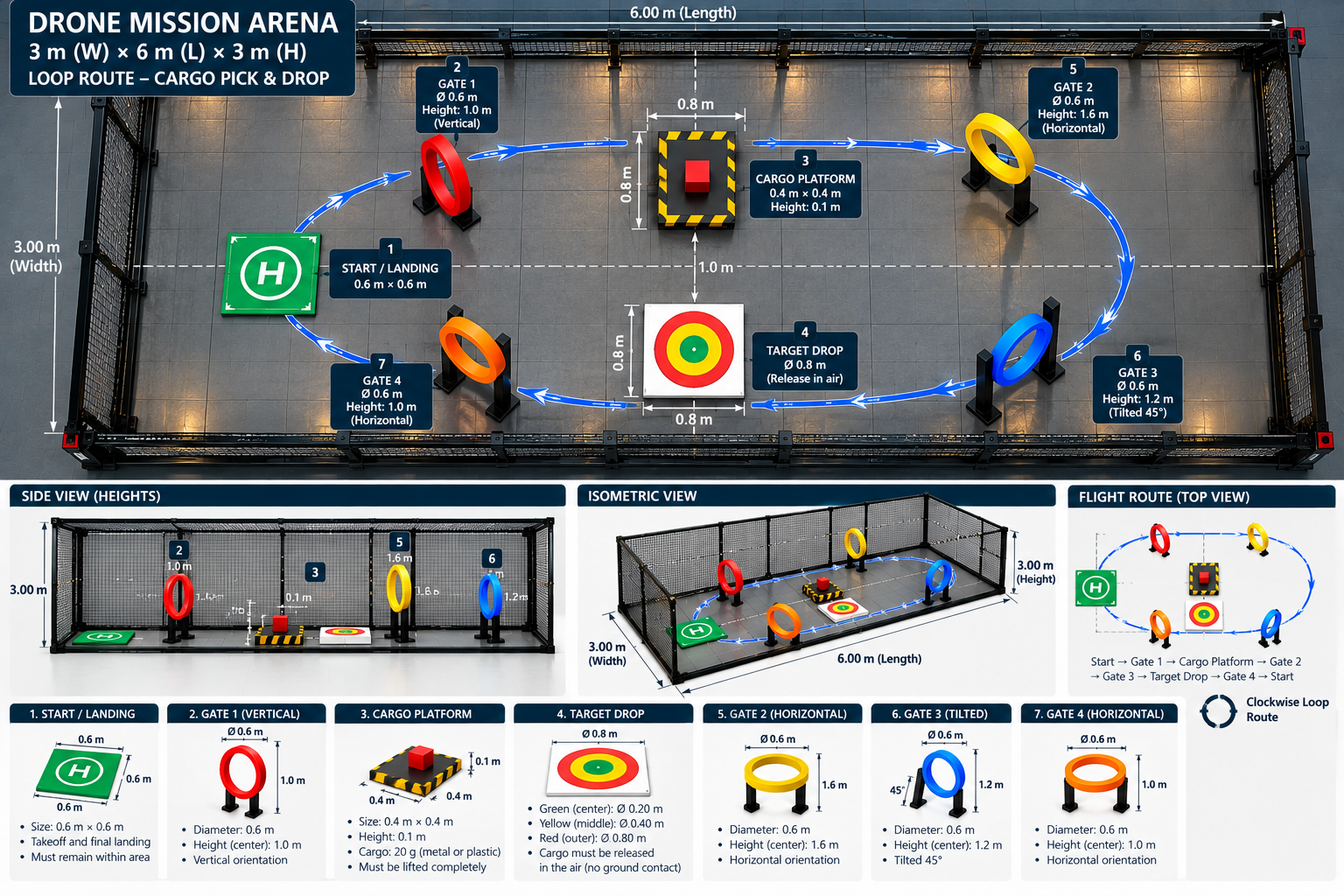
Complete the route in order: START → Gate 1 → Cargo Pickup → Gate 2 → Gate 3 → Target Area → Gate 4 → START/LANDING. All four gates are mandatory; the three-minute clock continues during retries and recovery.
Take off and pass Gate 1
Start fully inside the Start/Landing Area. Take off under control, then pass the entire drone through Gate 1 before approaching the cargo.
Acquire the cargo
Approach the pickup area, establish a controlled position, contact the cargo, lift it and carry it away. These achievements earn progressive points. If pickup is not possible, declare “Skip Cargo” and continue without it.
Pass Gates 2 and 3
Complete both gates in order. Each gate earns 20 points with cargo or 10 without cargo. A missed gate must be completed before later tasks can score in sequence; valid earlier points remain.
Deliver from the air or perform the alternative
Release the cargo while airborne into the target. Green, yellow and red zones award different points. Without cargo, reach the target, land under control and take off again for the alternative task; delivery and alternative-landing points cannot be combined.
Pass Gate 4 and land
Complete Gate 4, return to the Start/Landing Area and make a controlled final landing before the time limit. If recovery is needed, request authorised repositioning; the timer continues.
Scoring Table
Pickup points accumulate. Gate 2 and Gate 3 each award either the cargo-carrying or standard score. Cargo delivery and alternative target landing are mutually exclusive. Subtract penalties, floor each net run at zero and add the best two of three runs. Autonomous flight receives no automatic bonus.
| Action | Points |
|---|---|
| Controlled take-off | 10 |
| Gate 1 | 10 |
| Cargo area reached; controlled position established | 5 |
| Controlled cargo contact | +5 |
| Cargo fully lifted | +15 |
| Cargo carried away from pickup area | +15 |
| Gate 2: without cargo / carrying cargo | 10 / 20 |
| Gate 3: without cargo / carrying cargo | 10 / 20 |
| Aerial delivery: outer red zone | 25 |
| Aerial delivery: middle yellow zone | 40 |
| Aerial delivery: centre green zone | 60 |
| Alternative target task: reach / land / take off again | 5 + 10 + 5 |
| Gate 4 | 10 |
| Controlled final landing | 20 |
Tie-breaks: fewer recovery cards in counted runs; higher single-run net score; higher delivery score in a counted run; more completed gates in counted runs; shorter best complete mission; lower inspected take-off mass; then a tie-break run.
Penalty Rules
Recovery cards
Up to three recovery cards may be used per run when the drone remains technically safe. Only the referee or authorised field personnel reposition it. Each card costs five points and the clock continues.
−5 points per cardSequence and delivery requirements
A missed gate and later tasks performed out of sequence score zero until completed in the correct order. Cargo release while the drone is landed on or touching the target is invalid. Valid pickup points remain even if the cargo is later lost.
Affected task does not scorePilot authority and safety
Flight control by someone other than the designated pilot disqualifies the run. Unauthorised cage entry may stop the run and lead to penalties or disqualification. Unsafe flight may be stopped; a rerun after contact with a gate is not automatic.
Run termination / disqualificationCompetition Rules & Guidelines
Review the official competition rules, evaluation criteria, project requirements and submission guidelines before preparing your project.
Participation implies acceptance of the official rulebook. All teams, mentors, and students are expected to read, understand, and comply with the rules.