Drone Swarm Systems
Coordinate five autonomous drones in Operation: Seismic Rescue. Read changing QR information, determine the rescue code and aid target, deliver a package and return as a formation.
Search together. Deliver help.
A simulated disaster area needs help, and your team sends a coordinated group of drones to find where it is needed. The drones take off together, spread out to search and read clues that identify the rescue destination.
Once the system has located the request for aid, a delivery drone carries the package to the target. It then rejoins the others so the group can return and land together. After the start, the mission unfolds through the team’s software rather than manual flight instructions.
The challenge is to make individual drones behave like a dependable team: sharing a mission, interpreting information and completing a useful task together. The technical sections explain drone roles, markers, formations and scoring; consult the official rulebook for the complete requirements.
Swarm System Technical Specifications
Drone platforms are open: the category specifies no fixed universal size or mass cap. Every drone must pass inspection for safe simultaneous indoor flight, with full propeller guards, secure batteries, safe payloads and emergency shutdown. Size, mass, speed and behaviour remain subject to safety approval.
Autonomy and team roles
One permitted start command initiates the mission. Students monitor the system and perform only authorised recovery; they must not pilot, choose a target or enter detected digits. A designated student records every official run.
Traceable mission data
Centralised or distributed communication is permitted. The mission display must identify which drone detected each QR item and show the derived code and target. No particular communication protocol or cloud service is required.
Aid package and target
D5 starts with one lightweight package of approximately 3 × 3 × 3 cm. The correct drop zone is 50 cm in diameter. A package fully inside scores 20 points; touching the boundary without being fully inside scores 10; outside or in the wrong zone scores zero.
Flight preparation and safety
Fly only inside the enclosed safety area with secure propeller protection and healthy, securely mounted batteries. Keep people outside the cage while drones are airborne. Follow the referee’s instructions for emergency shutdown and authorised recovery.
Participation implies acceptance of the official rulebook. All teams, mentors, and students are expected to read, understand, and comply with the rules.
Competition Setup
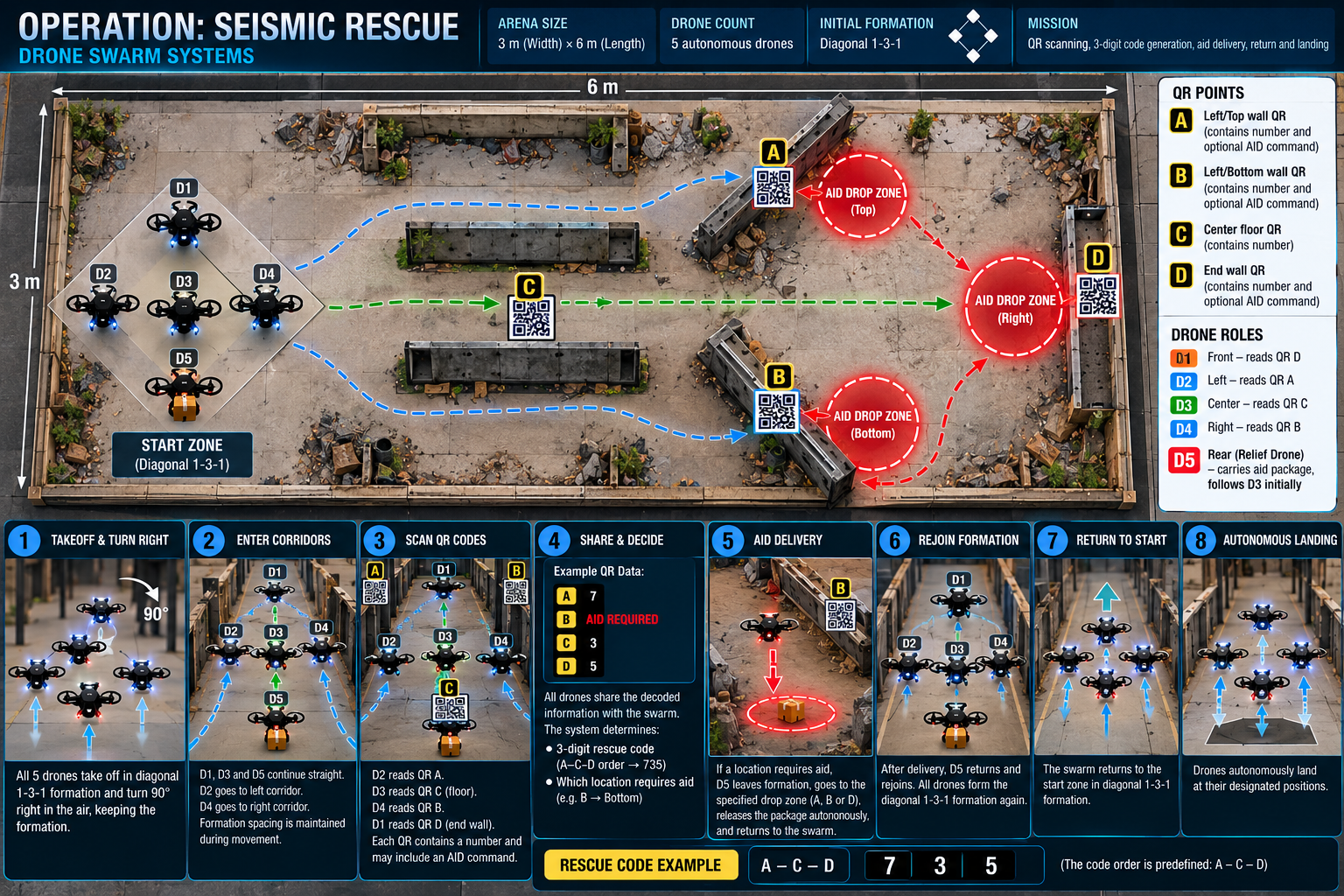
Operation: Seismic Rescue
Three official runs, each lasting up to five minutes. The best two run scores are added. QR values and the aid target change between official runs, so the mission must respond to detected information.
Take off, form up and turn
Launch all five drones autonomously from their marked positions, establish the diagonal 1–3–1 formation and turn 90 degrees right while preserving the formation.
Separate, scan and combine
D2 takes the left corridor and D4 the right; D1, D3 and D5 continue centrally. Read all four assigned QR markers and display the drone-originated data, Rescue Code and aid target.
Deliver aid to the detected target
D5 autonomously navigates to the A, B or D drop zone identified by AID REQUIRED and releases its package. Reaching the correct target and accurate delivery are scored separately.
Rejoin, return and land
D5 rejoins the swarm. Restore the 1–3–1 formation, return to the Start Zone and land autonomously. The mission ends on completion, team declaration or expiry of the five-minute limit.
Scoring System
The task values below are grouped for readability. One run scores at most 200 points; the best two of three runs yield at most 400. Each run counts one complete saved attempt, with its own penalties; task fragments from different attempts cannot be combined.
Take-off, formation and turn
Five-drone take-off: 10. Correct airborne 1–3–1 formation: 10. Coordinated 90-degree right turn: 10.
Search separation
D2 enters the left corridor: 5. D4 enters the right corridor: 5.
Four QR detections
Correct autonomous detection of QR-A, QR-B, QR-C and QR-D: 10 points each.
Mission information
Correct aid location: 15. Correct three-digit Rescue Code: 20. Visible, verifiable drone-originated QR data: 15.
Aid target and delivery
D5 reaches the correct target: 15. Package delivery: up to 20, according to its final position in the correct zone.
Rejoin and reconstruct
D5 rejoins the swarm: 5. All five drones reconstruct the 1–3–1 formation: 10.
Return and landing
Autonomous formation return to Start Zone: 10. Completed autonomous landing: 10.
Tie-breaks use the two counted runs: highest single run, more QR detections, more correct codes, better aid delivery, fewer penalties, shorter best complete mission, lower inspected fleet mass, then a tie-break run.
A requested restart cancels the active attempt, not the official five-minute clock. Reset under referee supervision with the same QR/target configuration. Earlier completed valid attempts remain saved; use the highest complete valid net attempt as the run score. An emergency stop is permitted for safety and is not itself misconduct; valid completed points may remain.
Penalties & Disqualification
Arena contact and drone collisions
Minor confirmed contact without damage may cost five points per event. A confirmed collision between team drones costs ten points; loss of control may end the attempt. Serious or deliberate arena damage can lead to disqualification.
−5 / −10 pointsIncorrect aid delivery
A package outside the correct zone scores zero for delivery. If deliberately sent to an incorrect zone, neither target-reach nor delivery points are awarded. Boundary contact in the correct zone scores 10 instead of 20.
Target and delivery rules applyManual flight intervention
Manual piloting, directional commands and manual target selection after START are prohibited and terminate the current attempt. The referee may stop unsafe flight immediately. People must remain outside the cage while drones are airborne.
Attempt terminatedCompetition Rules & Guidelines
Review the official competition rules, evaluation criteria, project requirements and submission guidelines before preparing your project.
Participation implies acceptance of the official rulebook. All teams, mentors, and students are expected to read, understand, and comply with the rules.